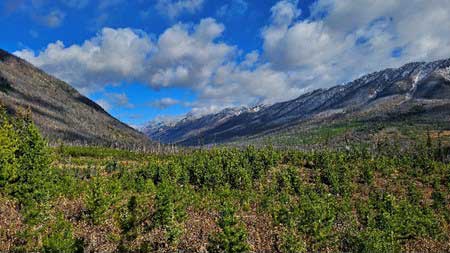
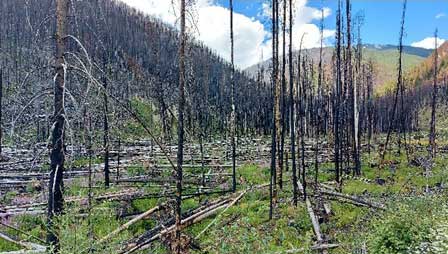
Fire can either support or disrupt corridor function, depending on its intensity and context. Upland forests and grasslands around Columbia Lake are naturally adapted to fire. At lower elevations, cultural burning historically helped maintain open forest stands and healthy grasslands.
The concern is not fire itself, but the shift away from frequent low-intensity fire toward fuel buildup and larger, more severe wildfire. Stewarding fire-resilient forests will be important in the years ahead, helping sustain a mosaic of forest ages, maintain mature and old-growth stands, and support functioning wildlife corridors and community safety.
Upland forests and grasslands around Columbia Lake are naturally adapted to fire, ʔa·kinq̓uku in Ktunaxa, of varying intensities. At low-er elevations, historical cultural burning maintained open forest stands and healthy grassland communities with fire return intervals of five to twenty years. This frequent low-intensity fire is a critical component of ecosystem function that maintains habitats for species such as American badger and Lewis’s woodpecker. However over the past 150 years, fire suppression has replaced this cycle, leading to fuel buildup and larger, catastrophic wildfire.
At higher elevations, high intensity fires often burn entire valleys and can affect wildlife corridor planning Severe fires drastically alter land-scape conditions and impact many species by increasing blowdown which can impede movement and removing forest canopy cover over entire valleys. Riparian and wet areas are often completely lost. Catastrophic wildfire is expected to increase in coming decades as a result of climate change and fuel accumulations. Stewarding for fire-resilient forests will be crucial in the years ahead to sustain a mosaic of forest species and age classes, and retain mature and old growth stands that contribute to functioning wildlife corridors and community safety.
Returning cultural and prescribed fire to the landscape is a critical component to ecosystem function in the Critical Corridor Area of the broader Columbia Lake corridor. Use of fire in the broader corridor is also important for maintaining habitat features such a bighorn sheep transition ranges and mule deer summer range.