
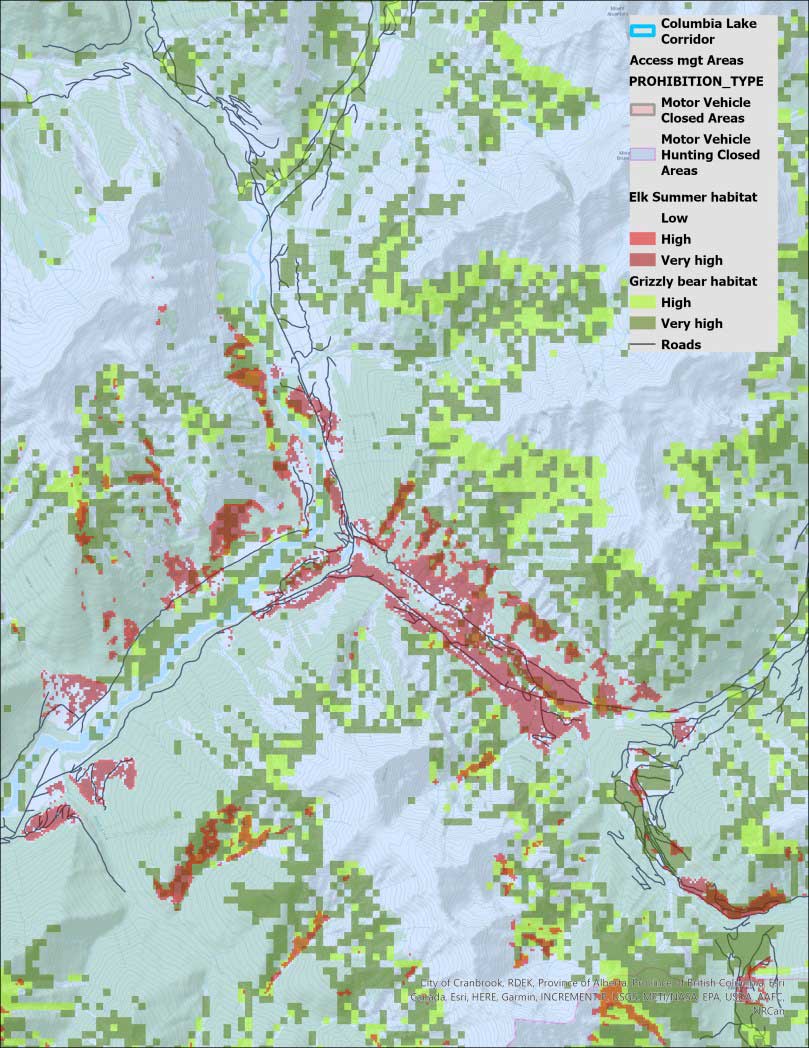
Area of high quality habitat for elk and grizzly bears with low road density.
Columbia Lake Ecological Corridor | Features | Access affects Elk and Grizzly Bear Habitat Quality
High-quality habitat alone cannot support elk and grizzly bears when disturbance is excessive. Both species also need secure areas away from open roads to move, feed, reproduce, and survive.
Across the Columbia Lake Ecological Corridor, high-quality habitat with fewer roads can improve security and permeability for seasonal elk and grizzly bear migration, as well as longer-distance dispersal, including movement between protected areas. Although numerous Access Management Areas and Hunting Vehicle Closure Areas already exist throughout the CLEC, stronger enforcement and additional designated areas should be considered where valuable habitat overlaps with dense local road networks. Access management measures may include deactivating roads, restricting vehicle access, and avoiding new roads or trails in intact, road-free areas.
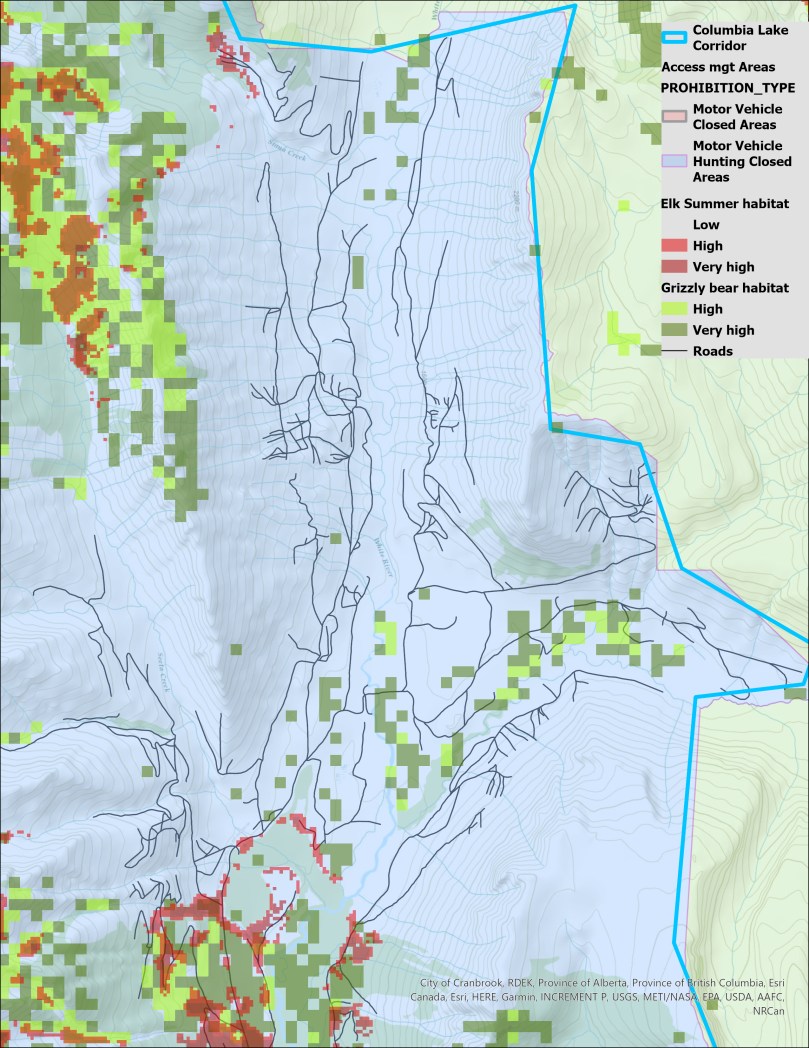
Area of low quality habitat for elk and grizzly bears with high road density
Habitat and road-density requirements
Access management should reflect the habitat needs of grizzly bears and elk. Peer-reviewed research indicates that both species thrive where high-quality habitat is combined with secure areas farther from open roads. Studies recommend keeping road density below 0.5–0.6 km/km² to support reproduction and survival.
Corridor design
Effective grizzly bear corridors combine the best available habitat with minimal human disturbance. Similarly, separating roads from foraging areas can help elk remain in landscapes with higher road densities while supporting connectivity.
Priorities for the Columbia Lake Ecological Corridor
Across the CLEC, high-quality habitat and greater security through lower road densities should improve permeability for seasonal elk and grizzly bear migration and for longer-distance dispersal, including park-to-park movement. Areas where high-value habitat overlaps with dense local road networks should therefore be prioritized for measures such as road deactivation or vehicle closures. The maps to the right illustrate two different conditions within the corridor.
Restoring elk migration
Migratory behaviour among elk has declined throughout the East Kootenays. Non-migratory elk experience higher human-caused mortality and show signs of nutritional stress. Enhancing high-elevation summer range has been recommended to help restore migration.
Enforcement and future development
Although numerous Access Management Areas and Hunting Vehicle Closure Areas already exist throughout the CLEC, stronger enforcement and additional designated areas are needed. New roads and trails should also be avoided in intact, road-free areas.
Benefits for other species
Implementing access-management best management practices would strengthen connectivity for grizzly bears and elk while likely improving habitat security and landscape connectivity for other wide-ranging species, including wolverine, mountain goat, moose, and lynx.
Sources and Further Reading:
- Friar, J.L., et al. 2008. Thresholds in landscape connectivity and mortality risks in response to growing road networks. J Appl Ecol 45:1504-1512. DOI: 10.1111/j.1365-2664.2008.01526.x
- Mulligan, K.L. 2021. Long-term changes in migratory patterns of elk (Cervus canadensis) in the southern Rocky Mountain Trench of British Columbia, Canada. MSc Thesis, University of Alberta. Edmonton, AB.
- Poole, K.G., et al. 2024. Migration, movements, and survival in a partially migratory elk (Cervus canadensis) population. Conserv Sci Pract 6:13128. DOI: 10.1111/csp2.13128
- Proctor, M.F., et al. 2023. Berries and Bullets: influence of food and mortality risk on grizzly bear in British Columbia. Wildl Monog. 213. DOI: 10.1002/wmon.1078.
- Rowland, M.M., et. al. 2018. Modeling elk nutrition and habitat use in western Oregon and Washington. Wildl Monog.199. DOI: 10.1002/wmon.1033